Tuesday, 28 July 2009

The Man Booker longlist


As mentioned, I have challenged myself to read all Man Booker winners and enjoying them so far. I have also decided to read the Man Booker 2009 Longlist announced today. The longlist nominated novels are as follows:

Byatt, AS The Children's Book

Coetzee, J M Summertime

Foulds, Adam The Quickening Maze

Hall, Sarah How to Paint a Dead Man

Harvey, Samantha The Wilderness

Lever, James Me Cheeta

Mantel, Hilary Wolf Hall

Mawer, Simon The Glass Room

O'Loughlin, Ed Not Untrue & Not Unkind

Scudamore, James Heliopolis

Tóibín, Colm Brooklyn

Trevor, William Love and Summer

Waters, Sarah The Little Stranger


I have read three of the thirteen nominated titles: The Wilderness by Samantha Harvey, Brooklyn by Colm Tóibín, and The Little Stranger by Sarah Waters (titles link to my reviews). I am delighted to see the first on the list, happy to see the second, and I expected to see the third; my redux post devoted to The Little Stranger suggested that I had missed something special on my first reading and although I am still not completely convinced, a place on the longlist supports my suspicions.

Some of the titles I hadn't heard of and another -Wolf Hall- I am not overly thrilled at having to read and not just because of its tome-like length. It is also going to take the longest to arrive in the library for me so it will be read last (I hope that the library request some more copies as otherwise I won't be able to read it in time). Neither Summertime and Love and Summer have been published yet but I have pre-ordered copies; everything else I have managed to reserve from my library and Me Cheeta, the one I am most surprised and intrigued by, I bought cheaply from Amazon. I haven't fully caught up on reading a synopsis for them all but so far the Coetzee is the one I am most looking forward to reading.

What about you? are you reading the longlist this year or wanting to read any you may be interested by? Are you excited by or happy to see some on the list?

The shortlist will be announced on September 8th and then the prize will be awarded to this year's winner on October 6th, which leaves me with ten weeks to read ten books.

At time of going to press I am also reading 1984 winner Hotel du Lac by Anita Brookner so look out for a review of that in coming posts. My sincerest apologies for the Booker-orientated road this blog is taking but this year's prize will only be a brief sojourn -interrupted by Persephone Reading Week- and normal service will resume in October!

Teaser Tuesdays


Quote a couple of spoiler-free sentences from the book you’re reading to tempt others.

"He was the only person - well, almost - who knew where she was going. He was, alas, not the only person who knew why she was going."
Hotel du Lac by Anita Brookner p. 29


Monday, 27 July 2009

The Group


The first time I came across mention of The Group by Mary McCarthy was on The Guardian's 1000 Novels Everyone Must Read list and I instantly wanted to read it. Its listing described it as:

An affectionate portrayal of eight Vassar-educated girls making their way in Depression-era New York — and a hilarious lampooning of the men who hang around them. The novel remained on the New York Times bestseller list for two years and still strikes a chord. Imagine Sex and the City with a social conscience, with characters saying things like: "But before we were married, we had an understanding that he should read Kafka and Joyce and Toynbee and the cultural anthropologists … so that semantically we can have the same referents".

I was disappointed to find that the book had fallen out of print here in the UK but heartened to discover that Virago are re-issuing the novel later this year. When I watched this great interview with Sarah Waters in May and found out that she was re-reading The Group and thought it "a fantastic book" I sought it out from the library. Now that I have read it I intend to still purchase a copy of the Virago reprint and reread it to unearth more of its gem-like quality. The Group is the type of novel that I would love to write.

I had preconceptions when I began reading it (Sex and the City comparisons will do that and I love Sex and the City) and expected the group to be engaging with one another often, to all be given equal place in the narrative, for it to be wise but light and I was wrong on all counts, except for the wisdom. The Group is densely intelligent and to begin with I found it a little dry and not exactly dated but definitely telling of the 1930s setting (it was first published in 1963); however The Group is a satire and a highly witty one at that. The humour took me a little while to get but the discussions on motherhood had me wiping tears from my eyes. The novel is highly progressive in its open treatment of motherhood, sex, contraception, and marriage and also discusses Socialism and Communism, Lesbianism, race, and mental illness amongst the socio-economic backdrop of 1930s New York with a predominantly affluent and educated cast.

There is so much information given in the novel and I understand why Sarah Waters regards it as one of her favourites with its attention to historical detail and evocation of the time period. I wonder how influential The Group was on her own writing; there is one scene at lunch in the dining room of a mental hospital that greatly reminded me of a scene from Fingersmith.

I loved The Group and its feminist politics. I read Valley of the Dolls by Jacqueline Susann (a Virago Modern Classic) last year and loved it despite, and even because of, its "trashiness"; Valley of the Dolls is an iconic and often melodramatic feminist treatise, The Group is also just as seminal and undisputably better written. I adored the ending and the structure- the novel's events (each chapter an individual and important event in one of the girls' lives) framed by the wedding of one of the group Kay to Harald at the opening and the funeral of one of the couple at its close. Not all eight girls are given equal page time and the novel more or less revolves around Kay and Harald and how their marriage impacts on the other girls. The book's events occur between '33 when the group graduate and '40, after World War II has broken out in Europe and before America's involvement. I was disappointed at first that Lakey, who was the most fascinating (to the group) group member and intriguing and compelling character (to the reader), didn't feature and was given her own story but the end of the novel and Lakey's return from Europe (where she spent the majority of the narrative excluding the framing events) more than made up for her literal, but not figurative, absence throughout. It wasn't until the last few chapters that I went from liking and admiring this novel to loving it; it's testimony to how an ending can often make or break a book.

A sample of the satire on motherhood approaches and of the language:

Accidentally she had put her finger on the truth, like accidentally hitting a scab. She was doing 'the most natural thing in the world', suckling her young, and for some peculiar reason it was completely unnatural, strained, and false, like a posed photograph. Everyone in the hospital knew this, her mother knew it, her visitors knew it; that was why they were all talking about her nursing and pretending that it was exciting, when it was not, except as a thing to talk about. In reality, what she had been doing was horrid, and right now, in the nursery, a baby's voice was rising to tell her so- the voice, in fact, that she had been refusing to listen to, though she had heard it for at least a week. It was making a natural request, in this day and age; it was asking for a bottle.

Has anyone else read The Group and loved it as I did? Has anyone seen the 1966 Sidney Lumet adpatation of the book, starring Candice Bergen as Lakey?


Sunday, 26 July 2009

Henrietta's War


MY DEAR READER,

Joyce Dennys created me in her image, an artist who married a doctor and moved to a quiet, coastal town in England during World War II and voiced her frustrations through my character. I originally appeared in the form of letters to my "childhood's friend" Robert, complete with witty illustrations, in an article for Sketch and became a successful, regular feature until the War ended. Now Bloomsbury have reissued the collected letters as part of their The Bloomsbury Group series.

Epistolary and autobiographical, my wartime experience is in the vein of 84 Charing Cross Road, charming and witty and with our own benefactress of edible delights in short supply. My friend Robert is serving overseas so I keep my news from the home front light and diverting. My letters feature a cast of highly amusing characters and I regale you with humorous acts of patriotism at home. Of much entertainment is my friend, Lady B:

"Before going to bed she sits down and writes a letter to Hitler, telling him just exactly what she thinks of him. She says it is has never failed to give her a good night's sleep. I think her great-grandchildren will enjoy those letters, don't you?"

I also indulge in descriptions of my dog Perry and his sufferings in an age where meat is rationed and there is a shortage of dog biscuits. His nature is so fickle that you would suppose he was a cat. His displeasure at dwindling meat supply, however, does not inspire dire humour as it does in humans:

"'I must say, I never thought I'd come to tripe,' said Colonel Simpkins sadly. Then his face brightened, 'If you ask me,' he said, 'I think this rationing is simply offal.'
And I had so hoped, Robert, that we were going to get through our first week of meat rationing without anybody making that joke."

Food and its shortage is prolific in my letters' content as I draw attention to the little sugar, margarine instead of butter, tinned rice instead of baked puddings, distress on the part of Cook, a Christmas dinner of reduced circumstance, parties where we bring our own tea, but I decline mention of the lack of bananas.

However, my husband Charles, is still sent "Charles's Cheese", a huge block of Stilton, sent every year by a grateful patient and the signal that Christmas is approaching. It is not the cheese that keeps us awake at night but the air raid sirens and incendiary bomb. There was also the badger that was thought a parachuter.

My accident proneness takes up some letter width:

"I dashed off to put away the mop which I happened to be holding in my hand and fell downstairs. I landed on my head, there was a loud cracking noise in my neck, and I thought what a silly way it was to get killed in the middle of a war."

Throughout prevails a sense of maintaining a stiff upper lip and patriotic outlook in times of adversity. One does what one can for one's country like giving blood, not without its own sacrifice:

"'I think you'd better put some of that blood back,' I said weakly.
'Keep perfectly still,' said the lieutenant, who had, presumably, witnessed so many blood-transfusion deaths that he wasn't going to start getting excited about mine.
But I didn't die."

My letters provide entertaining insight into jolly times of hardship on the home front.


Always your affectionate but not Childhood's Friend,
HENRIETTA


Saturday, 25 July 2009

Persuaded?


I thought I would share with you in this post an image of my copy of The Complete Novels of Jane Austen. Prompted by Claire at Kiss a Cloud's post this week on complete novels in the one volume I wanted to show off my Austen and stress that it isn't too heavy or cumbersome. I do own most, but not all, of Jane Austen's novels in individual copies but I found it hard to resist owning this edition, and not solely for the front cover.

As I previously mentioned, I signed up for the Everything Austen challenge, and intended to read Persuasion this summer, the only Jane Austen novel I hadn't yet read. Reading the blog of Nicola at Vintage Reads over the previous few months had intensified my desire to re-read some beloved Austen anyway and then I started to think that I should read the last unread one. Around this time I also read Simon at Stuck in a Book's poll post about which was the more loved novel, Pride and Prejudice (my favourite) or Persuasion (as yet unread)? The comments were illuminating -one analogy comparing it to the debate between which was the better of The Godfather and The Godfather II- and then hearing Michelle discuss this as her favourite novel at the first meeting of the Savidge Reads book group, I thought it probable that I was missing out by not having read Persuasion. Part of me had held off because I've read everything else by Austen and I tend to ration books by my favourite writers out, especially when they have a closed canon (due to their death) but now my curiosity was piqued - would Persuasion replace Pride & Prejudice as my favourite Austen novel?

The short answer to this is no; Pride and Prejudice will retain its position and always hold a special place in my heart but I did enjoy Persuasion immensely and appreciate its depth of passion and emotion. I read Pride and Prejudice as a hopelessly romantic teenager in the first throes of idealistic infatuation and in my opinion Persuasion is better appreciated by those who have loved and lost, with its powerful evocation of longing that anyone ever separated from the one they love will empathise with. I think that Persuasion is suitable for the more mature Austen fan, for those who have experienced love and not those who have just dreamt of it and gushed at Pride and Prejudice (and drooled over the culturally epic lake scene in the 1996 BBC adaptation).

I am pleased that I read these Austen novels in the order I did as love takes on a different look when you are older and not least when you are in a longterm committed relationship. Persuasion has a more mature outlook because it comes with the maturity brought about from lost love and separation and Anne Elliot is not as juvenile, impetuous nor as feisty as Elizabeth Bennett or Emma Wodehouse; although I still have a devout adoration of those two heroines, I admired Anne's internalised passion.

Anne Elliot has lost her bloom at the mature age of twenty-seven (!) and has been been pining for eight and a half years for Captain Frederick Wentworth whom her family and her friend, Lady Russell, who took the maternal place of Anne's own mother who had died, persuaded her was no good match. During the course of the novel, Anne and Captain Frederick become reacquainted through other friends and family and after the emotionally-charged first meeting and misunderstandings (as a result at times of their own and others' pride and prejudices) they are reunited and live happily ever after. It's a Jane Austen novel, where they always end in marriage, so I don't think I am spoiling the end for anyone.

This long passage and exchange about persuasion is the crux of the novel with the same title, embodying its passion, emotional turmoil, and maturity and wisdom of reflection. I think I will end with Jane Austen's words:

'To see you.' cried he, 'in the midst of those who could not be my well-wishers, to see your cousin close by you, conversing and smiling, and feel all the horrible eligibilities and proprieties of the match! To consider it as the certain wish of every being who could hope to influence you! Even, if your own feelings were reluctant or indifferent, to consider what powerful supports would be his! Was it not enough to make the fool of me which I appeared? How could I look on without agony? Was not the very sight of the friend who sat behind you, was not the recollection of what had been, the knowledge of her influence, the indelible, immovable impression of what persuasion had once done - was it not all against me?'

'You should have distinguished,' replied Anne. 'You should not have suspected me now; the case so different, and my age so different. If I was wrong in yielding to persuasion once, remember that it was to persuasion exerted on the side of safety, not of risk. When I yielded, I thought it was to duty; but no duty could be called in aid here. In marrying a man indifferent to me, all risk would have been incurred, and all duty violated.'

Friday, 24 July 2009

Recent Arrivals


I know how much you like to admire new books so I thought I would share the arrivals this week. Look out for reviews of these books in the coming days, weeks, and possibly months (have you being keeping count of my recent acquisitions and library loot?!)

Captivated: J. M. Barrie, the Du Mauriers and the Dark Side of Neverland by Piers Dudgeon is a book that I have been coveting for some time (since reading Daphne by Justine Picardie) and which Nymeth kindly chose from my wish-list and sent me after I won her Weekly Geeks quiz.

I Served the King of England by Bohumil Hrabal was sent to me by Vintage Books after I requested a copy of their pretty re-issue. Hrabal is a Czech writer I studied during a Slavonic literature course (I read and really enjoyed his most famous work, Closely Observed Trains) and have been desperately wanting to read this title.

The Bell Jar by Sylvia Plath was kindly sent by Faber at the bequest of Simon at Savidge Reads as it is the title chosen by him for next month's book group. I read this a decade ago (when I was going through my own period of teenage angst) and looking forward to a re-read. It's a lovely new cover -part of the Faber Firsts series to celebrate their 80th Birthday- and apologies for decapitating the debutante with a stray patch of sunlight!

The Wake by Jeremy Page is an ARC from Waterstone's and I am intrigued by its premise and looking forward to reading it (I intentionally sought this one out because I was excited).

The Optimist's Daughter by Eudora Welty is both a Pulitzer Prize winner, which I need to read for my personal challenge, and a Virago Modern Classic, which I collect. Recently I have been inspired (or should that be tempted?) to buy and read more Viragoes from reading Verity's Virago Venture. I would have sought out a green copy but I found this cover too pretty and reminiscent of the cover for this book, which I also own.

Henrietta's War: News from the Home Front 1939-42 by Joyce Dennys - published earlier this month as part of The Bloomsbury Group series I could resist the temptation no longer to purchase a copy. I have read so many effusively lovely things about this book here, here, and here and with such high praise the pressure is on to read and love this book... no, really, I can't wait to lose myself in it and don't think I will... wait.

The Other Hand by Chris Cleave is a book that I first read about (in the Guardian, I think), subsequently added to my wish-list in December of last year and then promptly forgot about until I read Claire's review in May (the book is published across the pond with a different title), added the paperback to my wish-list, then read Simon's review last week and realised that I couldn't wait to purchase it any longer. Now I see that Jackie has just read it too with a review pending so it will only be a matter of time until I pick it up! It has one of those vague, intriguing, shrouded-in-mystery descriptions that always peaks my literary curiosity. I am, however, approaching it cautiously as we all know what can happen when we anticipate a book with too much hype surrounding it.

I really must go and read now.

Thursday, 23 July 2009

Chimamanda Ngozi Adichie


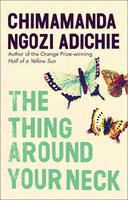
I forgot to mention in my Library Loot post this week that finally my requested copy of The Thing Around Your Neck by Chimamanda Ngozi Adichie is available to collect from the library. I have been desperate to read it since it was published in early April and now it is only six weeks until it is published in paperback. Oh well, I'll read it and purchase it at a later date. As it is I already have a head-start on reading the collection having read two of the short stories collected.

"A Private Experience" is one of the short stories.

Adichie's writing is understated but possesses a richness and a resonance that is powerful and profound. Both of her wonderful novels and now this short story (not the collection) concern the Nigerian Civil War (1967-70), also known as the Nigerian-Biafran War, where ethnic tensions and violence escalated. Adichie evokes the War in almost a minimalist way: a devastating truth and reality in a sentence written like a throw-away comment, not embellished or exaggerated but standing upon the merit of its own stark wording. The horror she can convey in one simple line is awe-inspiring and difficult to describe; its simplicity is implied but it is an artistic technique to pack so much punch in a few words. One of Adichie's literary idols is her fellow Nigerian writer -and the founding father of the modern African novel (an accolade given to him by Nelson Mandela) - Chinua Achebe, and he too possesses the gift of constructing words in such a simple yet brutal way, shocking the reader.

"A Private Experience" occurs over one day and night in a small, abandoned shop between two women: Chika, a Medical student and an Igbo Christian from Lagos, who is visiting her aunt in the town, and the nameless woman who leads her to shelter, who is a market trader with five children and also an Hausa Muslim. The women have sought safety from the violent street riot they were caught up in at the market; "Later, Chika will learn that, as she and the woman are speaking, Hausa Muslims are hacking down Igbo Christians with machetes, clubbing them with stones".

Chika has been separated from her sister Nnedi, and the woman from her eldest daughter; the story provides flash-forward hints to the fate of Nnedi and the future of Chika, who is the main protagonist, but not to the woman, excluding "perhaps the beginning of future grief on her face". The riots are a way of life to the woman but Chika has always been sheltered and somewhat oblivious, "Riots like this were what she read about in newspapers. Riots like this were what happened to other people". Their private experience is shared: two women -one nameless and unidentifiable, one not- who have a shared experience, despite their ethnic, religious and class differences. "The woman's crying is private, as though she is carrying out a necessary ritual that involves no one else" except for Chika who is witness to this personal moment; they also share the incongruous Medical exam of the woman's dry nipples. Later, when the private experience becomes the public, "Chika will read in the Guardian that "the reactionary Hausa-speaking Muslims in the North have a history of violence against non-Muslims", and in the middle of her grief, she will stop to remember that she examined the nipples and experienced the gentleness of a woman who is Hausa and Muslim."

The other short story from the collection I have read is "Cell One".

I believe that "Cell One" is the opening story in The Thing Around Your Neck and it definitely captured my attention from the opening lines:

The first time our house was robbed, it was our neighbor Osita who climbed in through the dining-room window and stole our TV and VCR, and the “Purple Rain” and “Thriller” videotapes that my father had brought back from America. The second time our house was robbed, it was my brother Nnamabia, who faked a break-in and stole my mother’s jewelry.

It starts after the fact, looking back; it is shocking and intriguing; it is dated and contains Western touches. This was not the first criminal act of the narrator's brother, nor would it be the last. The story centres around Nnamabia's arrest in his second year of university for belonging to a cult and his subsequent days in prison and in Cell One, the titular location for punishment. Typically Adichie, the story is told with subtle, understated language that nevertheless conveys horrific situations. It too is political although Chimamanda Ngozi Adichie states in this interview that she is not a political writer but a storyteller (watch the interview if you have time as I think she comes across as a very interesting and meditative writer). Adichie is indeed a storyteller, a wonderful one, and I look forward to reading the remainder of the collection, The Thing Around Your Neck.