Showing posts with label African Literature. Show all posts

Friday, 25 September 2009

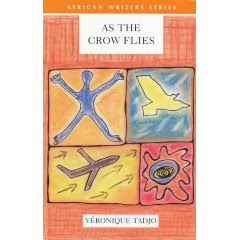
As the Crow Flies


If you want to love
Do so
To the ends of the earth
With no short cuts
Do so
As the crow flies.

Indeed I too would have loved to write one of those serene stories with a beginning and an end. As you know only too well, it is never like that, though. Lives mingle, people tame one another and part. Destinies are lost.

For my first concentrated foray into African literature (read my post yesterday for details about my self-project) I read As the Crow Flies by Véronique Tadjo. Translated from French by Wangũi Wa Goro, this very short and lyrical novel is set in the Côte d'Ivoire (the Ivory Coast; the Republic's government officially discourage the use of the name in English and instead wish it to be to be referred to as Côte d'Ivoire in all languages, which wasn't something I was aware of until writing this).

I only became aware of this title earlier this month when I read this post by Caustic Cover Critic about the forthcoming Penguin African Writers series reprints. Upon looking for more information about the novel I came across the above quote, which serves as a preface, and was instantly intrigued. Told through a series of vignettes, the novel has no central characters but a series of narratives identified -or not, as is the case- by pronouns. This cacophony of voices didn't work for me; I found it very confusing and I couldn't engage with random thoughts and actions of characters who weren't characterised. As the Crow Flies is poetical and reads like some poetry where commentary and events are only loosely -if at all- linked. I can understand the concept behind interconnecting voices that are each describing the various connections made in love and life but for me it didn't work as I didn't become engaged.

The landscape is indistinguishable with the setting never identified except as a city; there are two references to Africa that place it there. In one vignette the narrator mentions a conference of African writers where "one of the speakers proclaims: 'It is our duty to understand our place in the history of humanity. An African literature cannot exist until we liberate ourselves from the arrogant criticism of the West.'" This was a thought-provoking section and one that I associate with Chinua Achebe who has been vocal about the role of African literature and is very much considered the father of modern African literature (an accolade given to him by Nelson Mandela).

Some of the vignettes take the form of allegory and proverb which was interesting. In one section a couple decide to have a child; "On the following day the woman was pregnant. Before the end of the day, she had given birth to a boy."

If you enjoy gentle, lyrical prose that engages subtly with ideas then this short read is for you. Ultimately my interest wasn't sustained in the writing although there are passages of beauty:


You must leave before you die, before the flame that ignites hope fades. Leave before indifference sets in, before too much is said and silence sealed. Leave while there is still time with your desire which conquers the sea. Supreme and beautiful. An immense placenta, a liquid prison.
There will be no tomorrow, but only the sea and sky paving themselves a passage across the horizon.

Love is a story that we must never stop telling. Let yourself be lulled by its sweet words. Adorn yourself with its multiple charms but please, do not not spoil your life. True love, excuses in the name of love, sacrifices, disappointments. You must survive.

I dream of my country, which obsesses me all the time. I carry it with me all day. At night, it lies next to me, making love with me.




Thursday, 24 September 2009

African Literature


Recently I have been contemplating gaps in my reading or areas of literature where I would like to be more knowledgeable. I am a relatively diverse reader and do read a number of books in translation. Primarily any reading in translation that I've done this year has been French; there has also been a handful of texts ranging from Eastern Europe to Russia to Japan. However, this isn't necessarily about reading books that aren't written in English, my native tongue, but more about continents and cultures that I want to read more about.

The noticeable gap in my reading this year has been African Literature. So far I have only read The Thing Around Your Neck by Chimamanda Ngozi Adichie and Disgrace and Summertime by South African writer, JM Coetzee., which is hardly encompassing of a disparate continent. Tackling literature from any continent is always going to result in gaps that can't quite be painted over and would be quite the undertaking in full. My experience of Africa is so slim that some of the countries are unknown to me and geographically I wouldn't know Afrikaans literature from Zimbabwean, which is partly why I want to read more to fill in the gaps and become less ignorant. I intend to take it a book at a time, mostly from the collection of African literature I have built up over the last few ears. Nigerian literature is rich and varied and where most of my African reading experience comes from; I intend to read more from the Nigerian authors I have on my shelves -I have thoroughly enjoyed what I have read so far- as well as sampling from different countries where I can.

This is a list of books I currently have unread on my "African" shelf. Have you read any of these? If so, which would you recommend? More importantly, have you read any African literature not on my list that you enjoyed (especially something that isn't Nigerian to move me out of my obvious comfort zone)?

Nervous Conditions by Tsitsi Dangarembga (Zimbabwean)
The Book of Not by Tsitsi Dangarembga
The Famished Road by Ben Okri (Nigerian)
The Palm-Wine Drinkard by Amos Tutuola (Nigerian)
The Beautyful Ones are Not Yet Born by Ayi Kwei Armah (Ghanaian)
The Joys of Motherhood by Buchi Emecheta (Nigerian)
Anthills of the Savannah by Chinua Achebe (Nigerian)
Arrow of God by Chinua Achebe
Weep Not, Child by Ngũgĩ wa Thiong'o (Kenyan and referred to as Ngũgĩ)
Petals of Blood by Ngũgĩ

Tomorrow I will be reviewing a title not on the list that is West African in origin.

Tuesday, 18 August 2009

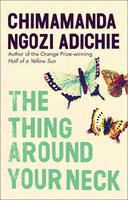
The Thing Around Your Neck


"At night, something would wrap itself around your neck, something that very nearly
choked you before you fell asleep."


Last month I closely read and reviewed two of the short stories from the collection The Thing Around Your Neck by Chimamanda Ngozi Adichie in anticipation of reading the others, which I now have.

I enjoyed this volume; Adichie's writing is evocative and intense but I didn't think that the stories had the same impact as her novels. Some stood out and overall I found the political ones, the ones set in Nigeria, to be more powerful, especially "The American Embassy". In the others, she focused on the alienation of Nigerians living in the United States and I found them to be a little cold and disconnected, even jarring, which may have been the point to evoke the incongruity and the hard work of adjusting to a new country, culture, and language. Anyway, I liked those stories but I didn't emotionally connect with them as I did the others.

The stand-out story for me was the last in the volume, "The Headstrong Historian", which can be read here. Not set in recent Nigeria nor in America, this story is about the wife of a fringe character from Things Fall Apart by Chinua Achebe and parallels the great African Literature story of Okonkwo. In Adichie's debut novel, Purple Hibiscus, she pays tribute to Achebe, the "grandfather of African Literature (an accolade paid by Nelson Mandela), and in this story she does so again by telling the story of the wife of Obierika, Okonkwo's wife. Set amongst the Igbo tribe in the fictional villages of Umuofia, it tells the struggle of Nwambga ,following the death of Obierika, to provide for their son Anikwenwa, with the help of White missionaries. I re-read Things Fall Apart four years ago so my memory was not fresh enough to say how closely the story parallels the events of the novel but I noticed a couple of clever allusions, the same recalled memory or cultural tale. By far, this was the story that most impressed me.

Have you read these stories? How do you think they compare to Chimamanda Ngozi Adichie's novels, if you have read them?


Thursday, 23 July 2009

Chimamanda Ngozi Adichie


I forgot to mention in my Library Loot post this week that finally my requested copy of The Thing Around Your Neck by Chimamanda Ngozi Adichie is available to collect from the library. I have been desperate to read it since it was published in early April and now it is only six weeks until it is published in paperback. Oh well, I'll read it and purchase it at a later date. As it is I already have a head-start on reading the collection having read two of the short stories collected.

"A Private Experience" is one of the short stories.

Adichie's writing is understated but possesses a richness and a resonance that is powerful and profound. Both of her wonderful novels and now this short story (not the collection) concern the Nigerian Civil War (1967-70), also known as the Nigerian-Biafran War, where ethnic tensions and violence escalated. Adichie evokes the War in almost a minimalist way: a devastating truth and reality in a sentence written like a throw-away comment, not embellished or exaggerated but standing upon the merit of its own stark wording. The horror she can convey in one simple line is awe-inspiring and difficult to describe; its simplicity is implied but it is an artistic technique to pack so much punch in a few words. One of Adichie's literary idols is her fellow Nigerian writer -and the founding father of the modern African novel (an accolade given to him by Nelson Mandela) - Chinua Achebe, and he too possesses the gift of constructing words in such a simple yet brutal way, shocking the reader.

"A Private Experience" occurs over one day and night in a small, abandoned shop between two women: Chika, a Medical student and an Igbo Christian from Lagos, who is visiting her aunt in the town, and the nameless woman who leads her to shelter, who is a market trader with five children and also an Hausa Muslim. The women have sought safety from the violent street riot they were caught up in at the market; "Later, Chika will learn that, as she and the woman are speaking, Hausa Muslims are hacking down Igbo Christians with machetes, clubbing them with stones".

Chika has been separated from her sister Nnedi, and the woman from her eldest daughter; the story provides flash-forward hints to the fate of Nnedi and the future of Chika, who is the main protagonist, but not to the woman, excluding "perhaps the beginning of future grief on her face". The riots are a way of life to the woman but Chika has always been sheltered and somewhat oblivious, "Riots like this were what she read about in newspapers. Riots like this were what happened to other people". Their private experience is shared: two women -one nameless and unidentifiable, one not- who have a shared experience, despite their ethnic, religious and class differences. "The woman's crying is private, as though she is carrying out a necessary ritual that involves no one else" except for Chika who is witness to this personal moment; they also share the incongruous Medical exam of the woman's dry nipples. Later, when the private experience becomes the public, "Chika will read in the Guardian that "the reactionary Hausa-speaking Muslims in the North have a history of violence against non-Muslims", and in the middle of her grief, she will stop to remember that she examined the nipples and experienced the gentleness of a woman who is Hausa and Muslim."

The other short story from the collection I have read is "Cell One".

I believe that "Cell One" is the opening story in The Thing Around Your Neck and it definitely captured my attention from the opening lines:

The first time our house was robbed, it was our neighbor Osita who climbed in through the dining-room window and stole our TV and VCR, and the “Purple Rain” and “Thriller” videotapes that my father had brought back from America. The second time our house was robbed, it was my brother Nnamabia, who faked a break-in and stole my mother’s jewelry.

It starts after the fact, looking back; it is shocking and intriguing; it is dated and contains Western touches. This was not the first criminal act of the narrator's brother, nor would it be the last. The story centres around Nnamabia's arrest in his second year of university for belonging to a cult and his subsequent days in prison and in Cell One, the titular location for punishment. Typically Adichie, the story is told with subtle, understated language that nevertheless conveys horrific situations. It too is political although Chimamanda Ngozi Adichie states in this interview that she is not a political writer but a storyteller (watch the interview if you have time as I think she comes across as a very interesting and meditative writer). Adichie is indeed a storyteller, a wonderful one, and I look forward to reading the remainder of the collection, The Thing Around Your Neck.